Product Description
Speed ratio adjustment:
1)Press the black rubber button on the instrument for 3 seconds, then it will enter into the speed ratio setup mode, if the button is released for 3 seconds, it will exit the speed ratio setup mode, and automatically retain the setting data.
2)After entering the setup mode, press the button, the value will be increasing, and release the button, then press it again, the number will be decreasing; the adjustment range of speed ratio: 1-300, The stepping value is 0.1 for the range 1-12 and 0.5 for range 12-300. Adjust the ratio value to what you want, then release the button for 3 seconds, the digital automatic will automatically save.
3)If your transmitter is installed on the flywheel, the ratio value is equal to the number of the engine gear; if the speed signals come from w point signal, the ratio value is equal to half electrode plate (Poles/2). If it is the gasoline engine, the speed ratio is equal to the number of cylinders (cylinder/2).
Specification:
Operating Voltage: 9-32VDC
Operating current: 60mA
Operating temperature: -30+75
Storage temperature: -40+85
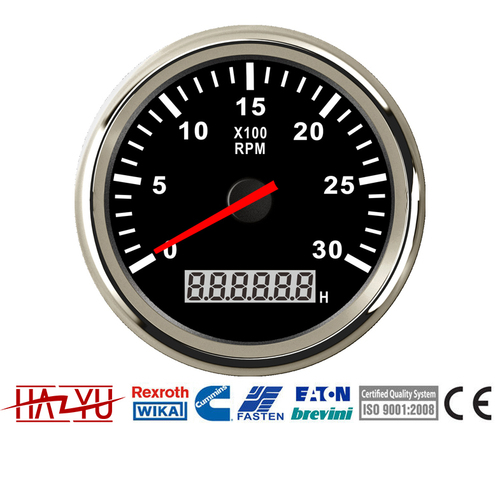
Versatile Compatibility and InstallationThe tachometer is universally compatible, fitting most 12V vehicles. Its standard gauge diameter and universal dash mount make installation straightforward for manufacturers, suppliers, or end-users. Wired connection to the ignition coil or ECU ensures stable and accurate signal reception, simplifying integration into various automotive systems.
Durable Design for Demanding EnvironmentsProtected by a corrosion-resistant coating, this tachometer withstands harsh automotive settings. It boasts IP54 ingress protection and is shock and vibration resistant, ensuring dependable operation in various driving conditions-maintaining accuracy even on rough roads or during fluctuating temperatures from -20C to 70C.
Modern, Clear, and Efficient ReadabilityFeaturing an analog dial with LED backlighting, the tachometer delivers excellent visibility both day and night. The clear and easy-to-read face allows users to monitor engine RPM at a glance, promoting better engine management and enhancing vehicle safety. The low power consumption ensures minimal impact on your vehicle's electrical system.
FAQ's of Automotive RPM Tachometer Gauge:
Q: How do I install the Automotive RPM Tachometer Gauge on my vehicle?
A: Installation is simple-mount the gauge on your dashboard using the universal dash mount. Connect the wired terminals to your vehicle's ignition coil or ECU pulse for accurate RPM readings. Detailed instructions are typically included with the product for hassle-free setup.
Q: What vehicles are compatible with this tachometer gauge?
A: This tachometer is compatible with most 12V automobiles, making it suitable for a wide range of cars, trucks, and other vehicles that use a standard 12V electrical system.
Q: When is it necessary to monitor engine RPM with a tachometer like this?
A: Monitoring engine RPM is essential for efficient engine performance, diagnosing mechanical issues, and preventing over-revving. It is especially useful during engine tuning, performance monitoring, or when driving under varying load conditions.
Q: Where is the best location to mount the tachometer in a vehicle?
A: The gauge is designed for universal dash mounting. It should be placed in an easily visible location on the dashboard, allowing the driver to monitor RPM levels safely without distraction.
Q: What is the benefit of the LED backlighting on this analog tachometer?
A: The LED backlighting ensures the dial remains visible in low-light or night-time conditions, enhancing readability and safety by allowing drivers to monitor engine speed at any time.
Q: How does the gauge ensure durability and reliability in challenging conditions?
A: The tachometer features shock and vibration resistance, IP54 ingress protection, and a corrosion-resistant matte or glossy finish. These features protect the gauge from dust, splashes, and harsh automotive environments, ensuring long-term reliability.
Q: What is the typical process for connecting the tachometer's signal wire?
A: The signal wire should be connected to the ignition coil or the ECU pulse output, depending on your vehicle's system. Ensure secure wiring and proper insulation for accurate and stable RPM measurement.

 +8617766397620


 +86 17712397510



 Send Inquiry
 Send Inquiry